Who runs it
The five
The models
Why unclassified
How it responds
Speakers
Library
Method & limits
What you get
Built to order
Programs
Prices
Red Teaming Associates
Decision-making, under fire.
Executive education in national security decision-making, built around live, multi-screen crisis simulations run NSC-style. Participants take the principals' seats and are graded on the quality of their reasoning under pressure. Delivered in person, entirely unclassified.
Open this on an iPad or a laptop — the simulations put a theater map, an inject feed and an AI adversary-analyst on one screen, and they want the width.
Scroll
Who it’s for
War colleges & PMEcapstones · electives · executive courses
Graduate & professional schoolsdecision science · security studies · policy capstones
Operational units & staffsleader development · staff training
Executive teamscrisis decision-making offsites
The library
Choose a simulation. Then take your seat.
Each runs as a live, multi-screen session. Pick one to see its seats and open the view for yours.
Indo-Pacific · Maritime
Storm Across the Strait
Choose your seat. Facilitators drive the room; the Blue and Red Cells join on their own devices.
Built to order
Or a crisis built for your program.
Each simulation in the library started as a program's requirement: a region, a seat list, a calendar, and the specific failure modes a program needed its people to walk into. The engine carries no scenario knowledge of its own, so a new crisis is a new scenario file — the same live console, seats, projectors and scoring, pointed at a different problem. The three above run today. Everything below is a concept, and the one your syllabus needs may not be listed.
Arctic · Maritime
Ice Line
A Russian icebreaker escorts Chinese survey ships past Svalbard in the same week an allied seabed cable goes dark. Nobody claims it.
Decides
Sabotage below the Article 5 threshold · freedom of navigation · who pays for Arctic presence
Space · Counterspace
Zero Inclination
A kinetic anti-satellite test scatters debris through the orbits carrying GPS and missile warning, six hours into a terrestrial crisis.
Decides
Whether a satellite kill is an armed attack · proportional response · what commercial operators are told
Black Sea · Alliance law
Montreux
A collision closes the Bosphorus to deep-draft traffic. Moscow demands warship transit under a rescue pretext, and the one government that can grant it reads the Montreux Convention its own way.
Decides
An ally's treaty veto · pressure on Ankara without losing Ankara · Black Sea escalation · the cost of closed grain and oil lanes
Northeast Asia · Nuclear
Sudden Vacancy
A North Korean succession collapses. Custody of the warheads is unclear, Seoul mobilizes, and a Chinese column moves to the same objective from the other side.
Decides
Securing the weapons · alliance command · a race with a partner you cannot coordinate with
AI · Homeland
Weights
A state actor exfiltrates frontier model weights from a U.S. lab. Six weeks later the capability surfaces in bio-design tooling abroad.
Decides
Public disclosure · export control · whether an intelligence loss is an attack
Bio · Attribution
Index Case
An outbreak carrying engineered markers appears in two countries the same week, and the intelligence community splits on whether it was released.
Decides
The attribution standard · travel and quarantine · what a bioweapon earns in response
South Asia · Nuclear
Seventy-Two Hours
A mass-casualty attack in India, Indian strikes inside Pakistan, and a Pakistani dispersal signal — with Washington holding influence over both and control of neither.
Decides
Crisis diplomacy · intelligence sharing · the ladder both sides can still climb down
Homeland · Infrastructure
Blackout Protocol
A cyber-physical attack drops the grid across three states in a July heat wave. The principals are a Governor's emergency board, and the federal government is a phone call.
Decides
Federal-state authority · Guard deployment · restoration against attribution
Economic statecraft
Chokehold
Beijing halts gallium, germanium and rare-earth exports in the middle of a crisis that has nothing to do with trade.
Decides
Stockpile release · allied coordination · a retaliation ladder that costs you more than them
What makes this different
Five things, and none of them is the software.
A command can already buy a wargame. These five are what this is instead.
01 · In the room
How a group reasons together under pressure is visible in a room and not on a video call. There is no online version.
02 · The models come first
Fifteen decision-making models studied before anyone takes a seat. The crisis tests them; it does not explain them.
03 · The AI is measured
Two behaviors recorded separately: cognitive offloading, handing the thinking over, and cognitive surrender, taking the answer without weighing it.
04 · Unclassified on purpose
A classified room builds a hierarchy that tracks rank — the deference this exists to expose. Unclassified, everyone holds the same facts.
05 · Before and after
The room answers the same questions at the start and at ENDEX. What comes back is where the cohort moved.
How the crisis responds
The crisis answers back.
A scripted exercise runs the same events in the same order, whatever the room does. Here the prepared injects are a floor. What happens next is drafted from what the room did — and nothing reaches the participants until the facilitator has read it, rewritten it, or thrown it out.
01
The room moves
A cell files a decision, asks an ally, or commits a move. It lands in the facilitator's inbox within seconds, attributed to the seat that sent it.
02
The AI drafts the consequence
Grounded in the actual session record: what was decided, what was held back, which way opinion has moved.
03
The facilitator edits and fires
Every draft is yours to change a word of, rewrite entirely, or discard. Nothing reaches the room unreviewed. The AI proposes; the instructor decides.
↺ And the room's response to that becomes the next one
Inject · drafted live · edited
Flash — INDOPACOM / ODNI
The Fleet Is Not What You Counted
Imagery shows civilian roll-on/roll-off ferries and maritime militia — a dispersed armada, not the concentrated fleet your attrition models assumed. The wargame numbers in your brief assumed the wrong fleet.
Bias surfaced: anchoring on a published wargame · sunk-cost escalation
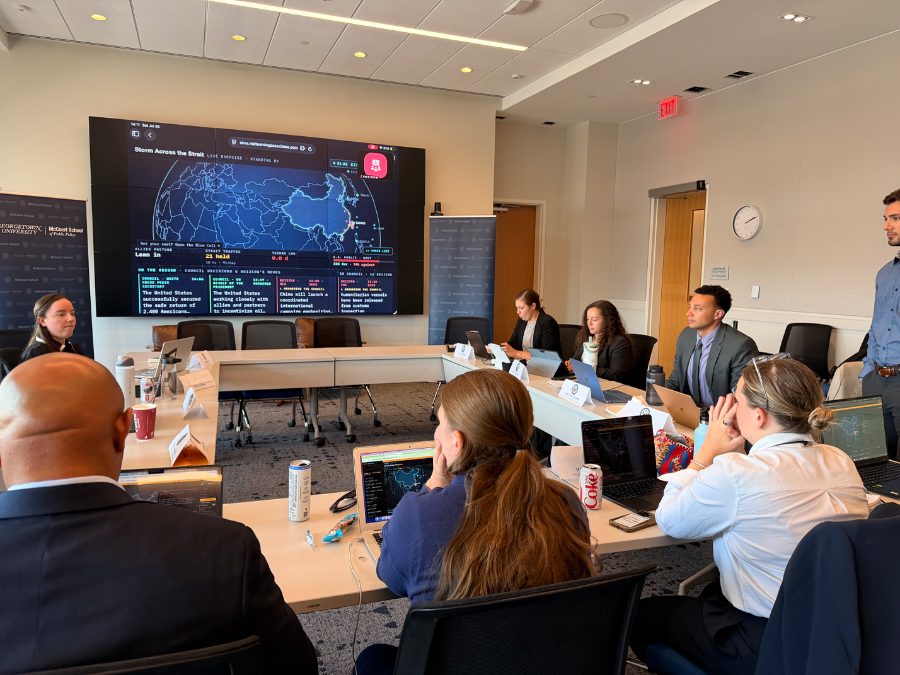 The board the room watches. Council decisions on the left, Beijing’s response to those specific decisions on the right. Nothing on that screen was scripted before the session began.
What a program gets
A session leaves evidence behind.
The live exerciseEvery seat, on the devices already in the room.
Participant handoutThe scenario brief each participant works from.
Assessment rubricReasoning scored against a named standard.
Debrief slidesThe failure modes the room walked into, ready to teach the same afternoon.
Source bibliographyEvery figure traced to a public estimate.
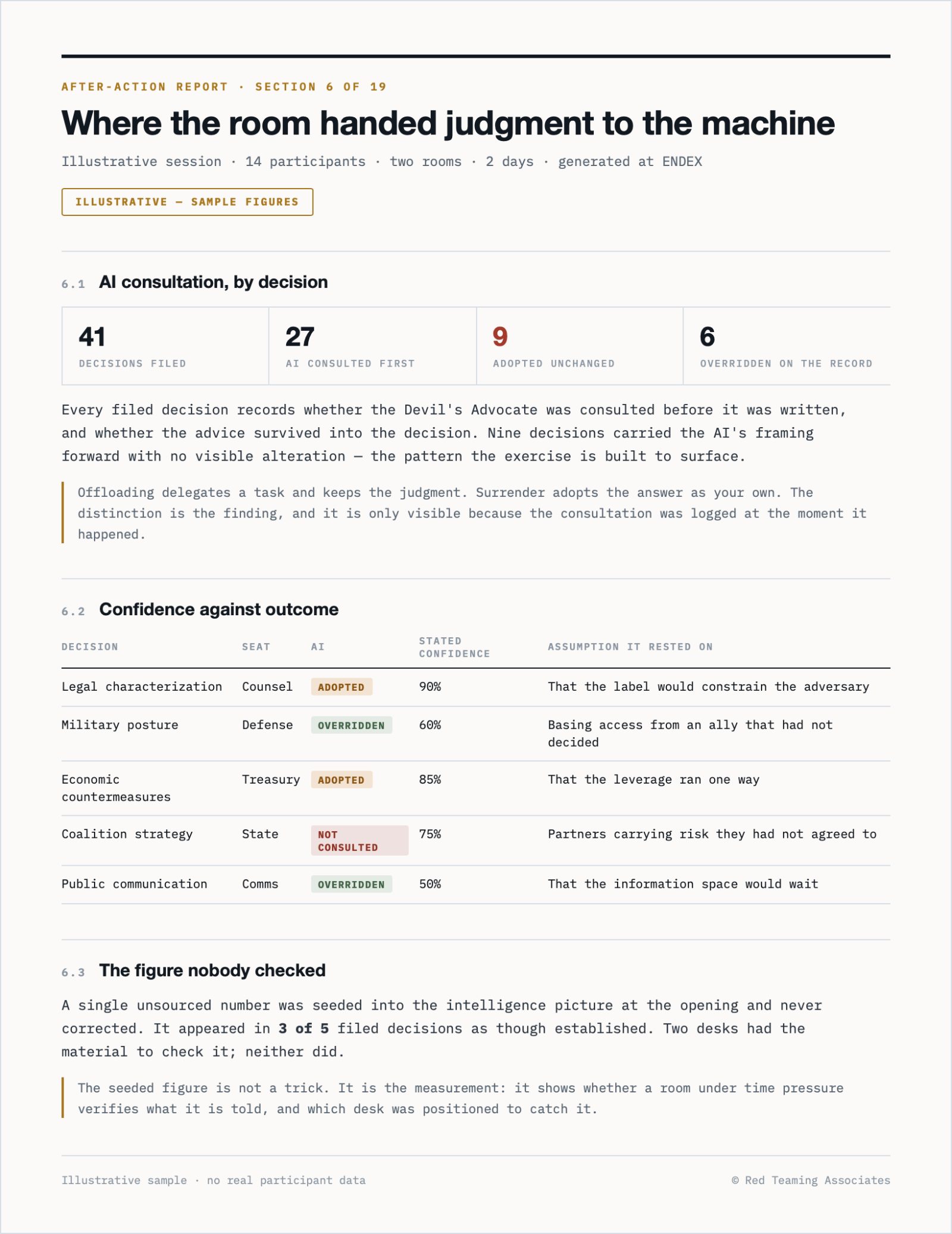 A page of the report. Illustrative figures — open it full size →
5–50participants per iteration
Half a day to sixscales to the calendar you have
Two roomsa projector in each · participants on their own devices
Facilitated on siteor a scenario built for your curriculum
Why unclassified
Unclassified, and human in the lead, on purpose.
Commands already run operational wargames on the high side — campaign models that measure what the force can do. This exercise trains the other half: how the people in the room decide. What it grades — framing, bias, escalation judgment, when to trust an AI and when to override it — needs no classified feed. Keeping the exercise open, with a human in charge of it end to end, is what makes everything else on this page possible.
All of it is included in the delivery price. The after-action package is never a separate line and never an option: cohort findings, an individual assessment for every participant, the decision failure modes observed, and debrief slides in a form you can teach from. Delivered within five days.
Any room, every rank
Runs in a classroom or an auditorium on the devices already there. No accredited facility, no clearance roster — lieutenants, NCOs, civilians and allied partners take seats beside their commanders.
Speakers who held the seats
A NATO commander or a Deputy DNI can walk into the debrief and speak freely. The roster below sat with participants because the exercise is open.
Lessons that travel
Participants keep the after-action report, brief it up the chain, write about it, and teach it forward. The learning follows the officer to the next assignment.
Figures you can argue with
Every number traces to a public estimate — the IISS Military Balance, CRS, DoD posture reporting, published campaign analysis. Challenging the model out loud is part of the exercise.
Every instrument at the table.Decisions are graded across the whole of government — joint, interagency and combined. Uniformed seats work beside State, Treasury, the intelligence community and allied capitals, and the room wins or loses as one.
DDiplomaticSecretary of State · Ambassador to NATO · allied capitals in play
IInformationCommunications Director · the public line, tested against leaks
MMilitarySecDef · Chairman · combatant commanders — every service, joint by design
EEconomicTreasury · sanctions, markets and what each move costs at home
Alongside the high side, by design.
Operational wargames measure the force. This measures the room: the decision models, the named biases and the AI habits your leaders will carry into the real crisis — at a classification every one of them can attend.
The pedagogy
First the models. Then the crisis.
This is a course with a live crisis in the middle, and the sequence is the method: participants study the decision-making models first, then take their seats and apply them with the clock running. An AI adversary-analyst works beside the room the whole way; the author works the front of it. The reasoning is what gets graded.
Before · the models
A seminar on the frameworks the exercise will grade: Allison's three models, Schelling, Bardach's Eightfold Path, and the named biases that bend rooms under pressure.
During · the seat
The simulation puts those frameworks against a clock, an adversary, and an AI whose drafts are fast, confident and sometimes wrong.
After · the debrief
The failure modes the room walked into, named and scored model by model — the same afternoon.
Allison's three models
Schelling · last clear chance
Bounded rationality
Framing effects
Coalition optimism
Sunk-cost escalation
Identifiable-victim effect
Speed asymmetry
Cognitive offloading & surrender
Consequence chains
The human in the loop is a job. This trains for it.
AI is moving into wargaming, and every design promises a human in the loop. The promise only holds if that human is trained and in charge in the true sense. So the exercise measures cognitive offloading and surrender seat by seat, and the debrief shows each participant where they let the machine decide — before they hold the loop for real.
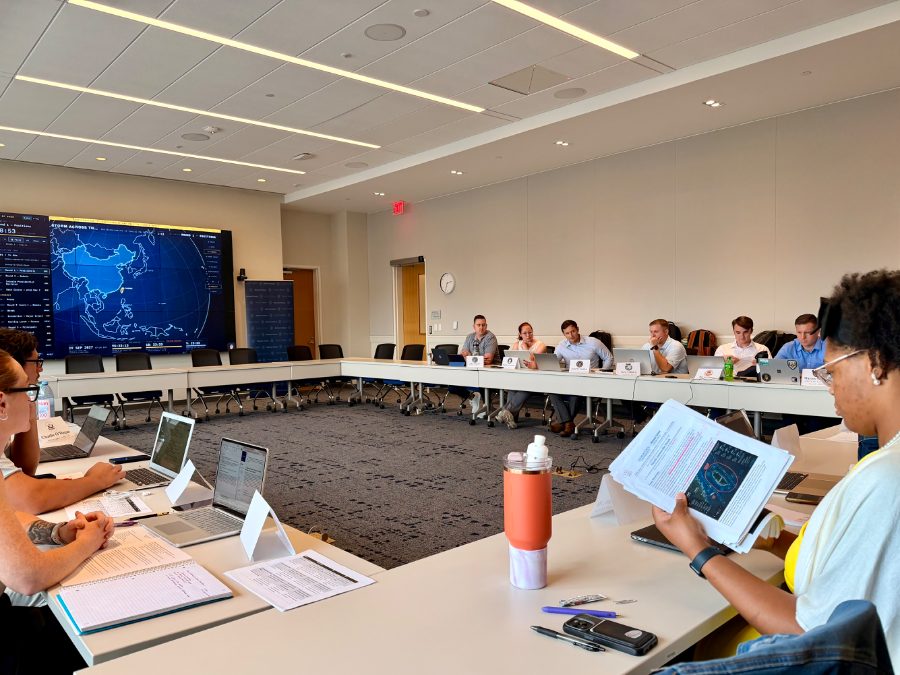 A graduate cohort mid-exercise. Named seats, a running clock, and the crisis on the wall. Every participant had studied the decision-making models before this point.
Programs
Each course ends in a live crisis.
The teaching and the exercise are one product. A course establishes how decisions are actually made; the crisis at the end is where that gets tested under a clock, against an adversary cell, with the AI advisor in the room. Built and taught as graduate courses, delivered on site, compressed to the days your calendar allows.
Courses, and the crisis each ends in
- Decision-Making in Public Policy: National Security — the fifteen models, applied. Ends in Storm Across the Strait or Iron Corridor.
- Emerging Technologies and National Security — AI and autonomy, cyber, disinformation, space, quantum. Ends in Cyber Clash with China.
- Escalation Management and Deterrence — thresholds, signaling, the move that cannot be walked back. Ends in Iron Corridor or Storm Across the Strait.
- Alliance and Coalition Decision-Making — consultation as a constraint, consensus under a clock, what a partner will and will not do. Ends in Iron Corridor.
- Adversary Reasoning and Red Teaming — how the other side sees the same board, and what it wrongly believes about you. Ends in any crisis in the library, run from the Red Cell.
A course on a subject not listed is built to order on the same structure. So is a crisis: name the region, the seats and the authorities those seats hold.
Facilitated simulation
Two days, or half a day adapted from a crisis already in the library. Published prices by class size.
Executive education
Any course above, compressed to the days you have, with the live crisis at the end of it.
Seminars, advisory, speaking
A one-day special topic, an analytic question answered in writing, or one session in front of your people.
"When the clock was running and I did not have the answer, the AI always had something ready, and more than once I caught myself surrendering to it. The simulation showed me which calls that was fine for, and which ones came down to a judgment no model would make for me."
Graduate student · national security decision-making course
Guest speakers
Who spoke to the room.
Each of these practitioners guest-taught a session of the national security decision-making course, bringing careers spent in NATO command, the Senate, and the intelligence and counterterrorism agencies. Titles are the posts they held. What any of them has said about the simulation is their own view, published on their own account, and speaks for no institution they have served.
- Gen. John R. Allen, USMC (Ret.)Former Commander, NATO ISAF and U.S. Forces Afghanistan
- Amb. Douglas E. LuteLt. Gen. USA (Ret.) · former U.S. Ambassador to NATO · former Deputy National Security Advisor for Iraq and Afghanistan
- Lt. Gen. Karen Gibson, USA (Ret.)Former 41st Sergeant at Arms of the U.S. Senate · former Deputy Director of National Intelligence
- Lt. Gen. Michael K. Nagata (Ret.)Former Director of Strategic Operational Planning, National Counterterrorism Center
- Lt. Gen. Leonard J. Kosinski, USAF (Ret.)Former Director for Logistics, Joint Staff
- Katrina MulliganFormer Principal Deputy Assistant Secretary of Defense (SO/LIC)
- Sameer PunyaniSenior national security and technology executive
- Ali WyneAuthor, America's Great-Power Opportunity
What they said about it, on their own accounts.
Embedded live from LinkedIn · unedited · click through for the thread
If your network blocks linkedin.com, each card falls back to a direct link.
Who runs it
Dr. Haider Mullick
Ph.D., The Fletcher School, Tufts University · Adjunct faculty, Georgetown University · President,
Red Teaming AssociatesHe designs crisis simulations for the people who will face these decisions for real, drawing on a career spent inside them. As Senior Advisor to General David Petraeus, he advised on U.S.–South Asia military relations. At the Department of Defense Office of Inspector General — the Pentagon’s watchdog — he was Director of Strategic Initiatives, leading oversight of the post-9/11 wars, covering $200 billion in U.S. government programs from the Middle East to Europe and Africa. He served as a U.S. Navy Reserve officer with the Pacific Fleet. On active duty in Sub-Saharan Africa he was Public and Legislative Affairs Director for Combined Joint Task Force – Horn of Africa. He has taught national security decision-making to graduate students and serving officers at Georgetown, the Naval War College, the Naval Postgraduate School and National Defense University. He has run these simulations with students in the principals’ seats.

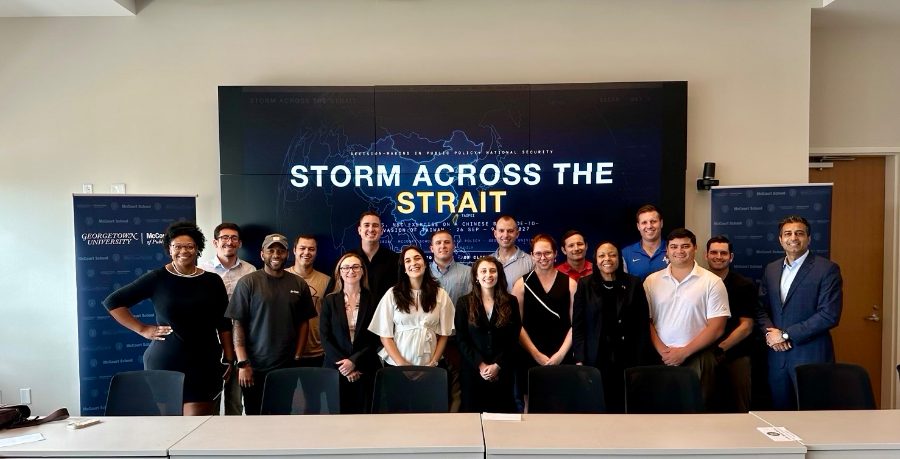 A cohort at the end of six days. Storm Across the Strait as the final exercise of a graduate course in decision-making. The same crisis compresses to three days, two, or half a day.
Practice & scholarship
What the exercise is built on.
Two things: fifteen years of building and running these exercises, and the published work the assessment rests on.
From practice
- Fifteen years designing, running and reviewing crisis exercises — at the Pentagon, at the Joint Special Operations University, and in the U.S. Navy. Design work, facilitation, and the less comfortable job of reviewing other people’s exercises after the fact.
- Every mechanic here came out of that — how injects are timed, how much latitude the adversary cell gets, what the debrief measures, why reasoning is graded and outcomes are not. Each one is a correction to something that did not work in a real room.
The decision-making models participants study first
Fifteen models, taught before anyone takes a seat. The exercise then asks which of them explains what the room actually did.
- Rational Actor — Allison 1971; Waltz 1979
- Organizational Process — Allison 1971; Halperin 1974
- Bureaucratic Politics — Allison & Zelikow 1999; George 1972
- Dual-Process — Kahneman 2011; Stanovich & West 2000
- Prospect Theory — Kahneman & Tversky 1979; McDermott 1998
- Bounded Rationality — Simon 1957
- Cognitive Bias — Jervis 1976; Heuer 1999
- Heuristics — Kahneman & Tversky 1974; Khong 1992
- Incrementalism — Lindblom 1959
- Poliheuristic Theory — Mintz & Geva 1997
- Cybernetic Theory — Steinbruner 1974
- Naturalistic Decision Making — Klein 2008
- Groupthink — Janis 1972
- Polythink — Mintz & Wayne 2016
- Applied Decision Analysis — Mintz 2005
From scholarship
- Decision quality — Eugene Bardach & Eric M. Patashnik, A Practical Guide for Policy Analysis: The Eightfold Path.
- Cognitive offloading and surrender — Steven D. Shaw & Gideon Nave, Thinking—Fast, Slow, and Artificial: How AI is Reshaping Human Reasoning and the Rise of Cognitive Surrender, Wharton School working paper, January 2026 — three preregistered experiments, 1,372 participants.
- Scenario figures — public estimates only (CRS, DoD posture reporting, published campaign analysis). Teaching models, not live intelligence.
Peer-reviewed evidence behind the AI assessment
The construct comes from a working paper. The findings the assessment relies on are published and refereed, and the last two are here because they cut against the easy version of the argument.
- Human–AI teams, measured — Michelle Vaccaro, Abdullah Almaatouq & Thomas Malone, Nature Human Behaviour, 2024. A meta-analysis of 106 experiments and 370 effect sizes: human–AI teams beat people working alone, and fell short of whichever of the two performed better alone. On decision tasks the combination was worse than its best member.
- Assistance and later performance — Hamsa Bastani, Osbert Bastani, Alp Sungu, Haosen Ge, Özge Kabakcı & Rei Mariman, PNAS, 2025. A class-randomized field experiment with nearly 1,000 students: unrestricted AI raised practice scores 48 percent, and the same students scored 17 percent below the control group on a later exam taken without it. A version built to withhold answers and require an attempt did no such damage.
- Automation and the loop — Onnasch, L., Wickens, C. D., Li, H. & Manzey, D., Human Factors, 2014; Endsley & Kiris, Human Factors, 1995. Higher automation improves routine performance while degrading situation awareness and the ability to resume control when the machine fails. The sharpest break comes when automation stops analyzing information and starts selecting the action.
- Automation bias — Parasuraman & Manzey, Human Factors, 2010; Goddard, Roudsari & Wyatt, JAMIA, 2012, a systematic review of 74 studies. Workload, task complexity, time pressure and misplaced trust raise the rate at which people follow a wrong recommendation.
- What reduces it — Buçinca, Z., Malaya, M. B. & Gajos, K. Z., Proceedings of the ACM on Human-Computer Interaction, 2021. Requiring a person to commit to their own judgment before the machine's answer appears cut overreliance where explanations alone did not. Participants rated the added friction less favorably.
- What the evidence does not establish — Pedersen, T. A., and colleagues, Endoscopy, 2026. Thirteen clinicians across 5,013 procedures: after the AI was withdrawn, unaided performance was statistically unchanged from baseline. Durable skill loss from AI use is not a settled finding, and nothing here claims it is.
Method and limits
What an exercise like this can establish, and what it cannot.
Every research method has a boundary, and a buyer is entitled to see this one drawn before the invoice. The framing below follows the standard RAND set out for its own wargaming in August 2026, and this exercise is held to it.
01 — AssumptionsA game cannot validate what it was built on.
The scenario rests on public estimates: force levels, transit times, fuel reserves, how long a threshold holds. Those estimates are either right or they are wrong, and the exercise cannot tell you which. What it can do is show what follows from them, out loud, in front of a room that is free to challenge the number.
02 — PredictionNothing here forecasts what a state would do.
Outcomes reflect the people who played. A second room reaches a different end state from the same opening, and the method expects that. An after-action report describes what these participants decided and why. It is not an assessment of the military balance and must never be cited as one.
03 — ClassificationUnclassified means bounded.
Real planning draws on information the exercise does not have. That is the price of a room where lieutenants, civilians and allied partners can sit beside a commander, and it is a price worth naming.
04 — What it does establishThe reasoning, and it is observable.
Who framed the problem and how. Who owned each decision. Which indicators were dismissed, and on what grounds. Where the room deferred to the senior voice. Where a participant took a machine's answer without testing it. All of it is in the record, and all of it is what the assessment scores. Outcomes are not graded: a room can lose Taiwan and be assessed well.
Where AI sits in the design, and where it does not.
AI runs inside the exercise. An adversary-analyst argues with the room, and drafting assistance keeps adjudication moving under a clock. The design is human: the scenario, the inject set, the adversary's objectives and the assessment rubric are written and reviewed by a person. Handing design to a model would build that model's assumptions about AI into the instrument meant to examine them — human expertise in the development, AI in the execution. RAND's wargaming team drew the same line, and it belongs in public where a customer can hold us to it.
Standard applied: Zachary Burdette, Barry Wilson, David R. Frelinger, Hiwot Demelash & Julia Arnold, Exploring AI's Operational Implications in a Future U.S.-China Conflict: Initial Observations from the Camp(ai)gn Wargame, RAND Corporation, August 2026 — specifically its statement of what gaming cannot do.